

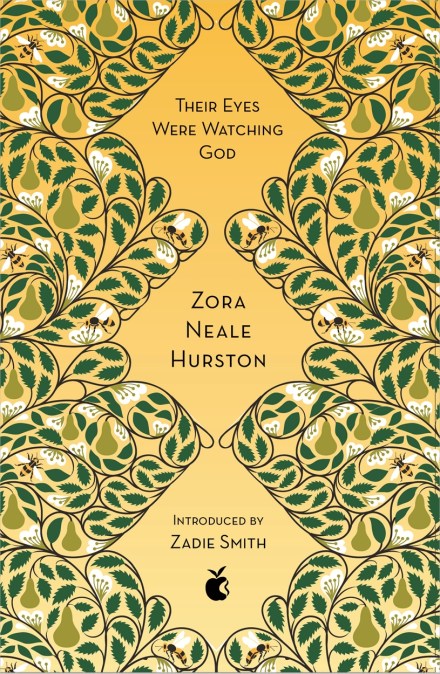
I first encountered Zora Neale Hurston's words purely by chance. In a London bookshop, a beautiful edition of Their Eyes Were Watching God caught my attention. Its cover — gold and green, patterned like a flowery web — seemed to glow among the shelves. Published by Virago Press, it drew me in like honey. I bought it without knowing that I was about to discover a writer whose words would linger with me long after I turned the final page.

Some novels stay with us because of their stories. This stayed with me because of its voice. The character’s rawness, specifically Janie, who, although she finds love in Tea Cake, her journey is one that will at least make your eyes slightly wet. She, and all of her characters, show strength, Black pride and culture in a world that dealt them all the wrong cards, yet they still decided to move forward. Her prose possessed a beauty that felt almost impossible to describe: lyrical without being sentimental, tender, and sharp. It was the kind of writing that changes how you read everything that comes after it. Her use of vernacular language and musicality raised my expectations for every work I have read after.
Who, then, was the woman behind such extraordinary work? Born in 1891, Zora Neale Hurston came into a world still haunted by slavery. All four of her grandparents had been enslaved. Her father was a carpenter and preacher, her mother a schoolteacher who encouraged her daughter's curiosity and independence. Hurston grew up in Eatonville, Florida, one of the first incorporated all-Black towns in the United States — a place where Black life existed outside the constant gaze of white authority. This experience would become central to her writing, which celebrated Black communities not merely through the lens of suffering but through their humour, complexity, traditions, and joy.
Before attending university, she worked as a maid in white households and held various jobs to support herself. Determined to continue her education, she famously lied about her age to return to high school. Her persistence eventually led her first to Howard University and then to Barnard College in New York, where she became the first Black student to graduate from the institution. Her insistence on getting an education will mark her future involvement in educational programs, and it shows a deeply determined spirit unwilling to stay where society told her she had to, breaking barriers in life as she did in writing.
By the 1920s, Hurston had become one of the brightest figures of the Harlem Renaissance. The movement represented an unprecedented flowering of African-American art, literature, music, and political thought. Writers, artists, and intellectuals challenged racist stereotypes while asserting the richness and complexity of Black culture. Alongside figures such as Langston Hughes, Hurston helped redefine American literature.
However, these historical facts cannot fully encompass who this woman was. Apart from just being “The Queen of the Harlem Renaissance”, she held a distinctive place even within that remarkable generation, which would later create some distance between those writers and her. While many Black intellectuals focused on directly confronting racial oppression and trying to prove their equal intellectuality to white authors — something that Hurston would later criticise — she insisted on portraying ordinary Black life in all its fullness. She resisted the idea that Black literature had to justify itself to its readers' demands or expectations, especially for works that could reach a White readership; she refused to reduce the African-American experience to White expectations.
This was, of course, strengthened in her writing by her training as an anthropologist. A field which has been- and sadly, still is- dominated by white, middle-class men. At Barnard, she studied under the influential anthropologist Franz Boas and went to the Caribbean to work. Long before oral history became a recognised scholarly practice, Hurston travelled through Black communities, collecting stories, songs, beliefs, and traditions that mainstream America dismissed or ignored. Her anthropological work shaped much of her writing.
Books such as Mules and Men and Tell My Horse blurred the boundaries between folklore, ethnography, memoir, and literature. During her travels in Haiti and Jamaica, she documented religious traditions such as Vodou with a seriousness and respect rarely found in contemporary accounts. Rather than treating these practices as exotic curiosities, she presented them as living systems of meaning created by people navigating history, faith, and survival.
Perhaps nowhere is Hurston’s radical vision more poignant than in her use of language. Hurston filled her work with Southern Black dialects and speech patterns. For me, this is one of the most crucial aspects of her work, because it is not just a stylistic choice. Language carries culture, memory, and a worldview. By preserving the rhythms of Black Southern speech, she preserved an entire way of understanding the world. Today, this might seem obvious, but in the early twentieth century such decisions were often criticised as unsophisticated. Hurston understood something that even today we are still struggling to grasp: there is no hierarchy of human expression and experience; every language, every dialect, every story contains knowledge worth preserving.
Despite her immense contributions, Hurston died in relative obscurity and absolute poverty in 1960. Her books went out of print. Literary taste shifted, and new political and cultural aesthetics were embraced. Misogyny undoubtedly played a role, as it has for countless women writers whose achievements have been minimised or forgotten. But Hurston’s disappearance also reflected a broader failure to preserve Black women’s intellectual legacies.
The tragedy of her neglect was visible in the condition of her grave. When Alice Walker, famous author of The Color Purple, searched for Hurston in the 1970s — an experience later translated into her article 'In Search of Zora Neale Hurston' — she found an unmarked burial site overgrown with weeds. Maybe Alice Walker did not intend this piece to become the powerful rediscovery that it became, but I am so glad it did. Her account remains an incredible, moving act of literary recovery in modern historiography because this article returned interest in Hurston. The abandonment, where “tall weeds choke the dirt road and scrape against the sides of the car”¹ created curiosity and interest in this phantom literary figure.
From here, scholars reassessed Hurston’s work. Feminist critics recognised the complexity of her portrayals of Black womanhood. Readers discovered what had been hidden in plain sight for decades. The use of the vernacular African-Americans in literature became a field of study at universities all over the world, including mine in Madrid, and started to get the recognition it deserves, of course, not only thanks to Hurston, but she is a fundamental piece of the puzzle. African-American and Black women became central to university studies, and new editions of her book appeared, such as the fantastic Vigaro edition I found.
But all of this might still leave you with the question: Why should you read Zora Neale Hurston today? The answer is both simple and incredibly complicated at the same time. She reminds us that culture does not belong exclusively to the powerful. This is partly because she preserved voices that institutions considered disposable, and partly because she understood that folklore, dialect, faith and other everyday experiences are worthy of serious artistic attention. Because she centred Black women without apology, with a complexity that is still today not always achieved. And because, in an age when cultural memory is increasingly fragile, commodified and controlled, her work stands as a reminder that stories disappear only when we allow them to — when books are banned, when we look the other way.
Hurston’s writing celebrates a world that America is still trying to erase: the working-class Black South. Reading her today is an act of recovery and resistance. Perhaps that's why I still think about the woman whose book first caught my eye on the shelf. Hurston once wrote: "Sometimes, I feel discriminated against, but it does not make me angry. It merely astonishes me. How can anyone deny themselves the pleasure of my company? It's beyond me." Neither do I know, Zora. Neither do I.