
words by Heidi Kewin
For a while now, I’ve found myself ritualistically returning to Tony Kushner’s Angels in America and I’m not sure why. It’s not an easy encounter – the play is a long eight-hour watch, but it’s made worthwhile by the performance of Andrew Garfield. It is, however, broken down into two parts, which makes it feel a little more episodic. Millennium Approaches (part one) is all about systems collapsing – bodies, relationships, institutions – and Perestroika concerns itself more with the difficult and uneven work of rebuilding. Perestroika is named after a policy of restructuring the economic and political systems in the former Soviet Union – Kushner is graciously meticulous in seizing this metaphor for the political and emotional transformations that his characters undergo. When watching the filmed production, it feels as if the play asks for the kind of stamina you’d need for athletics, though it’s far more rewarding due to the intimacy that unfolds. For the reader, it can be even more difficult, and I found myself asking: What is this play actually about?
Subtitled A Gay Fantasia on National Themes, the play moves restlessly between New York apartments, hospital rooms, dreamscapes, and celestial courts, weaving together the AIDS crisis, conservative politics, queer liberation, identity politics, Mormonism and theological doubt, and intimacies between both lovers and friends. Set against the bleak moral backdrop of Reagan-era America, the play takes on a feverish expansiveness: we’re watching history collide with theology, desire clashing with sin, the personal becoming political, and AIDS functioning not only as a medical condition, but as a lens through which a society’s hypocrisies and prejudices are made clear as day. It is restlessly intense, and a lot for just one play. Kushner – a gay man himself – pushes the play beyond what we would expect from a drama about AIDS, in the process exposing how limited the public imagination around the epidemic has been. And yet, I find that the play’s most unsettling power lies elsewhere: in the relentless act of lying to oneself in order to survive.
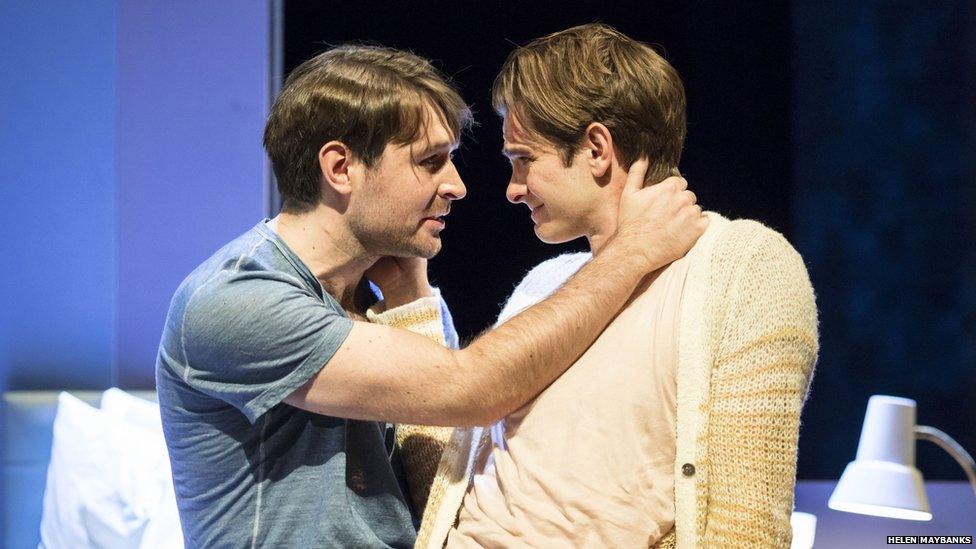 James McArdle as Louis and Andrew Garfield as Prior. C: Helen Maybanks
The plot of the play refuses to stay still, revolving around two couples who begin to share the same oxygen. The first character we meet is Prior Walter: a witty, camp New Yorker whose diagnosis with AIDS initiates the play’s descent into fear. His lover, Louis, loves him deeply, but cannot stomach the reality of having to watch someone he loves deteriorate both mentally and physically. Watching them act feels like looking at two friends in a real moment, not actors on a stage. Parallel to this is Joe, a devout and ambitious Mormon lawyer, but also a closeted homosexual – quite the pickle. Alongside him is his wife Harper, who numbs her suspicion of Joe’s homosexuality through Valium-induced hallucinations. These two worlds slowly – and messily – bleed into one another: Louis begins a slow, catastrophic retreat from Prior and forms a relationship with Joe, Harper drifts into fantastical hallucinations and Prior becomes a reluctant prophet-like character, receiving frequent visits of an Angel who proclaims a divine message he does not want to hear. The plot is linear, but it’s also a dreadfully slow and painful unmasking of each character’s confrontation with the truth, a truth they have spent most of their lives rehearsing to avoid. Diffused lighting onstage makes the scene seem as if it’s occurring outside conventional reality, and the tentative physical proximity underscores a fragile mutual recognition among the four; they apprehend one another not as strangers, but as figures similarly displaced by illness and instability.
The most particular, and even alien at times, character is Joe. His relationship with his Mormon faith is a tangled one – desire, for him, exists to be managed, trimmed, prayed away; something that is there but also isn’t, accessible but restricted. He believes that his queerness is temptation, and one that can be sublimated into obedience and service. By choosing to deny his flesh, Joe thinks he is choosing goodness, yet any member of the audience can see that this very choice can easily erode everything around him. One moment of the play finds Joe asking: “Do I look gay?” – a curious, speculative and rather humorous moment, but what struck me, and perhaps audience members too, is that something is visibly and physically askew: his tie is twisted. Joe stands in the standard Mormon uniform, and the moral framework of his life is slightly coming undone as his tie becomes less neat (and later comes off completely). I don’t believe this costume mishap was intentional when looking at the events and staging a few moments beforehand, nonetheless the tie is doing the work that Joe cannot do verbally. His identity is unravelling, and the audience can see that before he does. Left behind is Harper, less a wife and more of a symbol, someone kept in place to maintain an illusion of heterosexual wholeness. There, not because Joe wants her, but because his faith – and therefore denial – needs her.
After the questioning of how one ‘looks gay’, we shift to seeing Spiderman in drag. The stage is rotating, and Prior is shown in a single spotlight; a world in motion, where identity and love are not fixed, but a counter-image to Joe. Instead of suppressed, closeted instability, we see a figure aligned with queer performativity, spectacle and self-stylisation. It is a juxtaposition of repression and expression, as if Joe’s twisting inward tension is set directly against Prior’s aesthetic visibility. And here comes the brutally concise statement of the play: in this dreamlike state he finds Harper (also in a dreamlike state) and declares to her: “Your husband’s a homo”. Dream scenes are not common in contemporary plays, but mutual dream scenes are a different thing altogether. It’s tempting to treat the line as a darkly comic jab (even the audience is laughing along), but its underlying force is in what it exposes.
 Prior and Harper hold hands as they confront the truth of Joe’s closeted queerness. C: Apollo Bartel on YouTube
It’s a sentence that reverberates far beyond the dream scene: Joe’s Valium-addicted wife has now heard this secret out loud, having lived for years in proximity to such a truth that remains unspoken. Not only is her marriage dismantled, but her worldview too; the most devastating revelation – her husband’s homosexuality – is the one she has known all along but could not admit. Joe’s denial is anchored in his Mormon righteousness. He clings to an ideal of moral purity grounded in discipline and is convinced that if he simply reorders his queer desire into obedience to God, the gay will go away. But Kushner meticulously reveals how such repression calcifies into harm. Joe does not set out to injure or scar Harper; rather, he inhabits the narrative of being a devout Mormon husband that requires her – his doting, submissive wife – to serve as his alibi. AIDS itself has served as this symbol of love, or the lack and danger thereof. Joe can tell Harper that he loves her all he likes, but it comes out empty, stripped of its core meaning, more like an excuse, and this is all solidified into this moment of realisation.
Prior holds Harper’s hands and this is one of the only moments of the play when two characters touch – given the nature of the illness at hand, we can’t forget about the era’s misconceptions about AIDS and its contagion. Kushner has moved Prior into a kind of third zone here – one of honesty and confrontation – which brings a sharp edge to his character. We don’t know if he will live or die from his illness, so his separation from the real world in his dream scenes makes it hard to believe he is a character, also as he is so focused on talking to others (the audience included) like in a friendly, caring conversation. Prior stands as the collision of history, illness, sexuality, and divinity all taking place on a battleground. He is the character least seduced by denial; he refuses euphemism; he says things how they are, even when it is terrifying or life-changing (I believe we could all do with a friend like Prior in our lives). The miraculous and the mundane coexist in him: heavenly messengers arrive, prophecies unfold, and still he must focus on, and worry about, his lessons, his appointments, his shrinking world. He is an extraordinary character, insisting on remaining stubbornly human in the face of heartbreak. He chooses the jarring clarity of truth instead of the comfort of fantasy.
 Prior is approached by the Angel in his sleep. C: Drama Online
This makes Prior the most perfect character to be approached by an Angel – but it’s not an angel in the biblical sense. The costume is excessive, assembled and visibly constructed by other men on the stage holding her up. The skeletal wings are layered with fabric feathers, paired with wild and uncontrolled hair. Christian iconography is refuted; rather than an angel that is more ‘held together’, we see an unexpected mess, and her power is precarious despite her apparent status as the most powerful and divine character of the play. But, she is dependent on men holding her up, though that is another can of worms…
Seen together, alongside each other, through each other, under and above each other, these characters map a spectrum of evasions: Joe hides inside religion, Harper inside hallucinatory worlds, and Prior is the only one who cannot afford to flee, becoming the witness of the plot instead. What Kushner keeps demonstrating is that denial is rarely malicious: more often, it arrives as a form of care for oneself and a desperate attempt to preserve coherence when the world refuses to be coherent. If denial is, as the saying goes, a river in Egypt, then Kushner shows us what happens when the waters finally recede. What remains is painful, compromised, unfinished — but it is real. Kushner, through Prior, has given dignity back to those who experienced or died from AIDS, then and now. Angels in America is a play to some, but to others, it is an important piece of collective memory and a monument in its own right.
--
Heidi Kewin is the Founding Editor-in-Chief and an occasional writer for Zimmer Magazine. Alongside, she works as a photographer, graphic designer and a TEFL (Teaching English as a Foreign Language) teacher to Ukrainian refugees. She is in her third year of a Bachelor’s degree in English and Related Literature at the University of York and is eagerly awaiting acceptance into a master’s program. You can contact Heidi to discuss Zimmer at heidi[at]zimmermagazine.com