
words by Heidi Kewin
On 20th February 1999, at the age of 27, the playwright Sarah Kane died by suicide. This reignited, understandably, the wave of criticism surrounding her legacy to the British theatre — one of resurgence and realignment. Her play Blasted (1995) in particular is a work that shocked theatre out of its creative hibernation, and it’s no surprise that it provokes such outrage.
When I was around thirteen or fourteen, my mum told me I was “too young” to watch a Sarah Kane play. As a young girl, I would stop at nothing to be more independent, and it felt like she was limiting me. In retrospect, her comment was incredibly revealing. Though a child shouldn’t be exposed to Kane’s depictions of violence and emotional exposure, her play’s contents don’t become easier with age or experience – no one can ever be adequately prepared for what such a play demands.
In-yer-face theatre is a term used to describe an emergence of British drama in the 1990s, seeking to confront and challenge sensitive subjects which mainstream theatre had often strayed away from. It’s the equivalent of being grabbed by the neck and shook until you become aware of something. When mentioning the topics of Sarah Kane’s plays, it’s natural for people to respond with unease or concern: Blasted is a text no longer taught in university courses; critics and tabloid journalists reacted with immediate fury to the initial production of the play at the Royal Court Theatre Upstairs in London, condemning as a “disgusting feast of filth”, mere voyeuristic obsession and moralising nonsense. But this media frenzy and controversy is exactly what Kane wanted.
Her writing is extreme to say the least, confronting audiences with graphic depictions of violence, vivid sexual abuse, murder, cannibalism, and emotional disintegration. Blasted refuses restraint and forces spectators into prolonged encounters with suffering that could not possibly be comfortable for anyone. Kane advocated for pushing the theatrical experience to its limits, not only inviting viewers to observe pain from a short distance, but, also implicating the act of turning away is itself a moral failure. Kane saw theatre as a football match, and, as a staunch Manchester United fan, it’s not a surprise that she used this analogy. She herself confessed to frequently walking out of the theatre without a care in the world, “but however bad I’ve felt, I’ve never left a football match early, because you never know when a miracle might occur.” It’s interesting, however, that her own audiences walked away from her productions before they ended. The question is, then, not why Kane’s theatre disturbs us, but why audiences are so quick to turn away from work that demands such emotional confrontation.
Behind this artistic outlook was a woman with a beautiful heart, marked by her “empathy and compassion and joy” after she took her life. She was intensely political and intellectually sharp – though it doesn’t take a genius to read her work and come to this conclusion – while also battling severe depression and existential despair. All the while, she led herself to a reputation of brutal honesty, provocative ideas and a vision to search for truth in a world she often found dishonest. A character in Crave (1998) has the line “I write the truth and it kills me”, and in an interview, Sarah Kane proclaimed that she felt the same. The media presented her as sickening – of course; she was a female author who became famous at a precocious age for presenting dark, transgressive topics in the 1990s, what we’d describe in more recent days as an icon. Her adolescence was committed to Christianity, but her adulthood was more devoted to rejecting those beliefs, prompting her to describe her estrangement from God as her “first relationship breakup”. Deconstructing the Christian faith through language of loss and rupture recurs throughout her work and, through Blasted, we’re prompted to think about our own relationships, our morality, and our presence when others around us are suffering.
Blasted takes place in a hotel room in Leeds – slightly claustrophobic, sealed, domestic and recognisable for an audience. The two characters are Ian and Cate – ex-lovers – and Ian’s treatment of Cate unfolds without any theatrical cushioning: the audience sit firmly in their seats witnessing private brutality and forced to remain present. The proximity here is crucial to understanding why Kane’s theatre repels as much as it compels. The urge to walk away when we recognise horror is instinctive, but in Blasted that instinct is provoked by recognition. The setting is depressingly normal, and situating such violence inside such a familiar place strips audiences of the comfort of thinking acts of violence occur far away from us.

Ian (Robert Parsons) and Cate (Adrienne Walters) in ‘Blasted’. Photo by Cheshire Isaacs
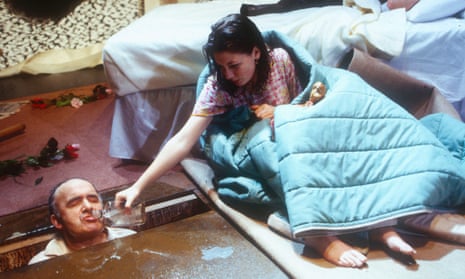
Ian (Pip Donaghy) and Cate (Kate Ashfield) in ‘Blasted’ at the Royal Court, London, in January 1995
It’s then no surprise that part of the backlash of Blasted came from audience members walking out during scenes of sexual violence and murder. The play’s extremity was well-known long before its premiere, and audiences and critics surely knew what they were signing up for and not going in blindly. However, anticipation did little to prepare them, and even those who thought themselves ready were confronted with the emotional weight of watching suffering unfold right before their eyes. The pacing, timing and staging of Blasted intensify this effect even further – scenes of brutality erupt suddenly out of moments of calm and the audience is offered no time to process or emotionally distance themselves. In 1990s Britain, theatre plays like the likes of An Inspector Calls and Arcadia had often been cautious, morally moderated and psychologically ‘safe,’ with narratives which reassured and crowd-pleased rather than probed and criticised. Even new writing by contemporaries such as Alan Ayckbourn presented social conflict with dark humour, but it rarely breached the visceral confrontation with physical suffering that Kane pursued. Blasted flips this on its head completely.
The act of leaving becomes part of the work itself. Audience withdrawal is both a failure of endurance and a form of participation, and there is discomfort in the knowledge that some audience members could leave, but maybe choose to remain. This dynamic contributes to Kane’s enduring reputation, as it’s hard to say whether her theatre would be as iconic or famous if it weren’t for such upheaval. Blasted was not the only example of this effect in theatre or the arts, and similar patterns can be seen elsewhere: Behzti (2004) was pulled after violent protests over its depiction of rape and murder in a Sikh temple, generating conversations about what can and can’t be said in the British theatre, and Stanley Kubrick’s A Clockwork Orange (1962) faced bans and moral panic over its graphic content before becoming an acknowledged classic.
Sarah Kane may never have fully grasped the magnitude of her own influence. Her untimely death at 27 years young robbed her of the chance to see how profoundly she reshaped British theatre. Kane did more than shock audiences, she illuminated our human capacity for empathy and moral reflections. She exposed a truth about ourselves: even when we know it is part of the world we live in, we instinctively turn away from suffering. People DNF books that make them feel uncomfortable, turn off horror films that disturb them, and exit the theatre when the play confronts our own complicity. It doesn’t come from ignorance, but rather human instinct – a desire to shield ourselves from pain we can’t bear.
Walking out of the theatre does not stop what’s happening on stage, in the same way that turning off BBC news does not stop the children from starving. And yet, Kane’s work demands that we resist that instinct and sit with the discomfort, recognising the humanity of suffering both on stage and in our lives. It could be the very fact that she could not see her own greatness that cements it, leaving the world to bear witness to a brilliance she herself could never fully inhabit.
--
Heidi Kewin is the Founding Editor-in-Chief and an occasional writer for Zimmer Magazine. Alongside, she works as a photographer, graphic designer and a TEFL (Teaching English as a Foreign Language) teacher to Ukrainian refugees. She is in her third year of a Bachelor’s degree in English and Related Literature at the University of York and is eagerly awaiting acceptance into a master’s program. You can contact Heidi to discuss Zimmer at heidi[at]zimmermagazine.com