

It appears that, for cinema, things will never be the same again. Does that sound a tad dramatic? Perhaps, but undoubtedly, the truth is that cinema has been reshaped this year, for better or worse. With Netflix’s recent announcement that they are aiming to purchase Warner Bros., the stick of dynamite looks to have been lit, with the alarm bells and klaxons of industry insiders and cinephiles surely ringing with doomsday concerns on their brow.
As an avid cinema-goer, I agree that Netflix’s policy of minimal cinematic release and increased streaming access to films is a concern for the future of picture houses and the ritual of relishing the big screen and popcorn. However, until those properties are forced to retreat entirely from the cinema, I will remain cautiously considerate of how things might play out in the future.
Why am I not joining the lynch mob, might you ask? Because in truth, Netflix has injected some much-needed finances into the industry, helping auteurs and screenwriters live out their dreams with projects they might not have the opportunity to bring to life. Money is tightening. Appetites are shifting. Cinema isn’t the same. Things have to change. And thankfully, Netflix’s offering of auteur-driven cinema has bedazzled 2025’s already sterling cinematic haul. Ranging from Edward Berger to Katheryn Bigelow, Noah Baumbach to Guillermo Del Toro, the bundle of joy that is Netflix’s 2025 filmic release contains astounding amounts of energy and impressive vision, even to the extent that Netflix is somewhat responsible for bringing to life my favourite film of the year in Clint Bentley’s Train Dreams.
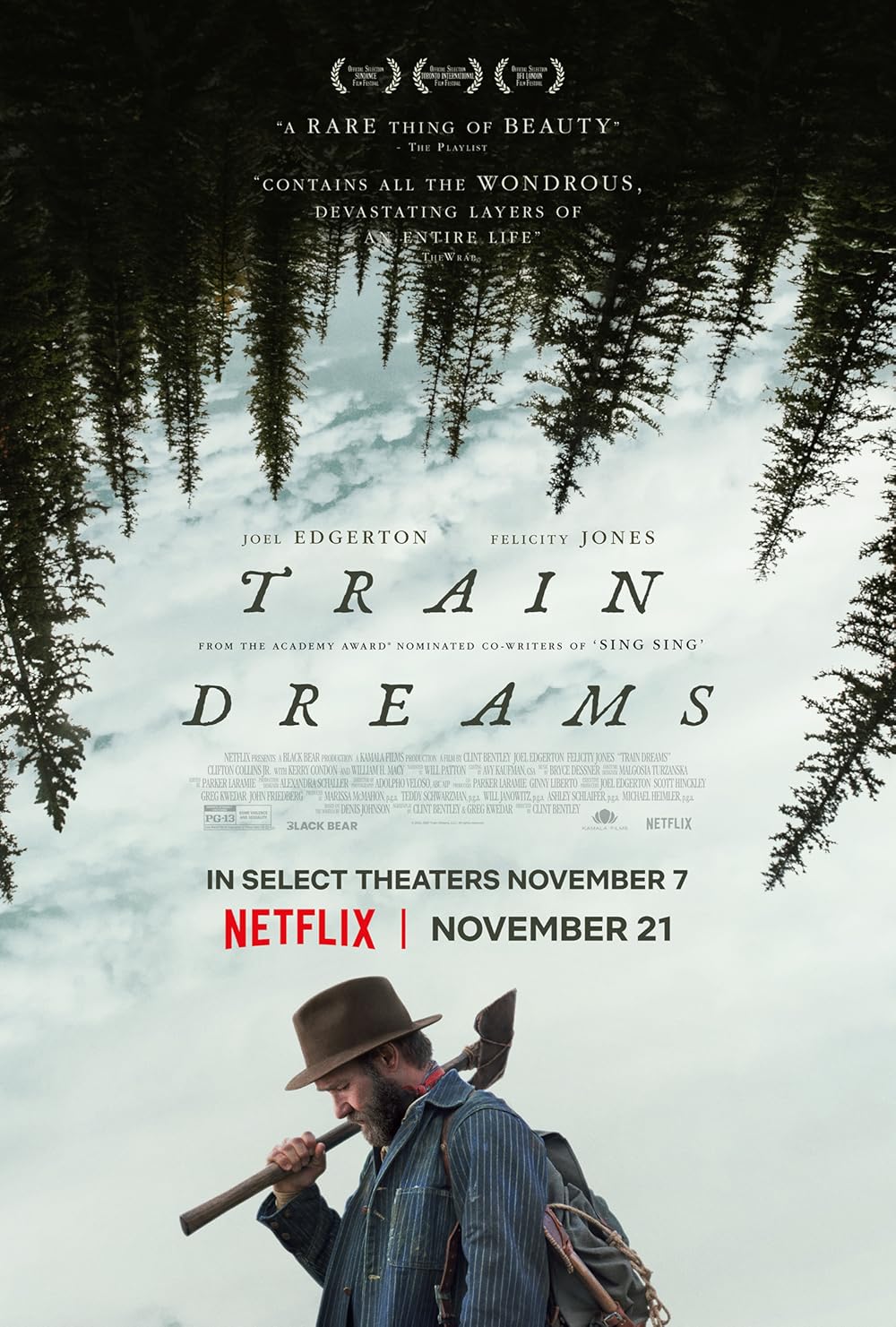
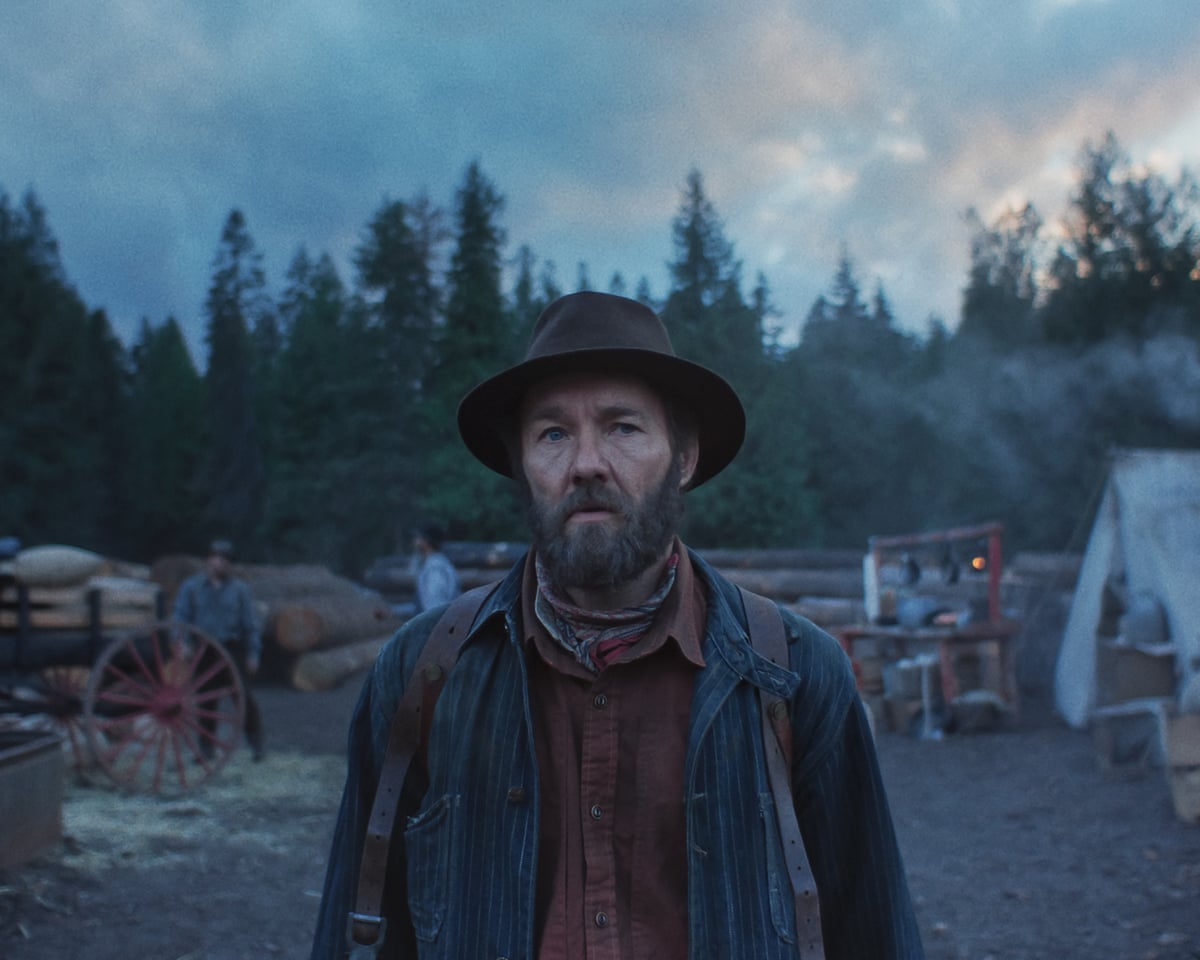
Only by an inch, Bentley’s film has pushed aside Paul Thomas Anderson’s One Battle After Another for my crowning appreciation and awe. Why, might you ask? Because, centrally, Bentley’s film is a soulful, poetic masterpiece that does an awful lot with only a small plot. Where it might lack the explosive architecture of tension and colourful characters, like Anderson’s flick, Train Dreams is a subtle odyssey into the life of a normal man whose life is ravaged by tragedy and punctuated by bewilderment as he witnesses the transformation of the American frontier. As Bentley’s camera maps out the erosion of the old world and the slow assembly of the new American 20th century, the pictorial patterns of felled trees, callous-gloved men, and the gradual comatose state of pastoral Americana are used to augment the surreal changes experienced by the protagonist Robert Grainier (Joel Edgerton). It is a film that rockets Edgerton to the height of his artistry, as he positions Grainier as a sombre man, who, much like Forrest Gump, is an open-eyed witness to the world and its changes.
On my second viewing of the film, so enamoured was I by its ease and poignant quiet, I found myself revisiting memories of reading Walt Whitman’s 'Leaves of Grass', a poetic landmark from my days at university. In particular, Whitman’s poem, 'Crossing Brooklyn Ferry', emerged from the flinty bedrock of Whitman’s collection as a parallel to Bentley’s film.

Fulton Ferry Boat (Brooklyn, New York), July 1890 via The Library of Congress, Washington DC
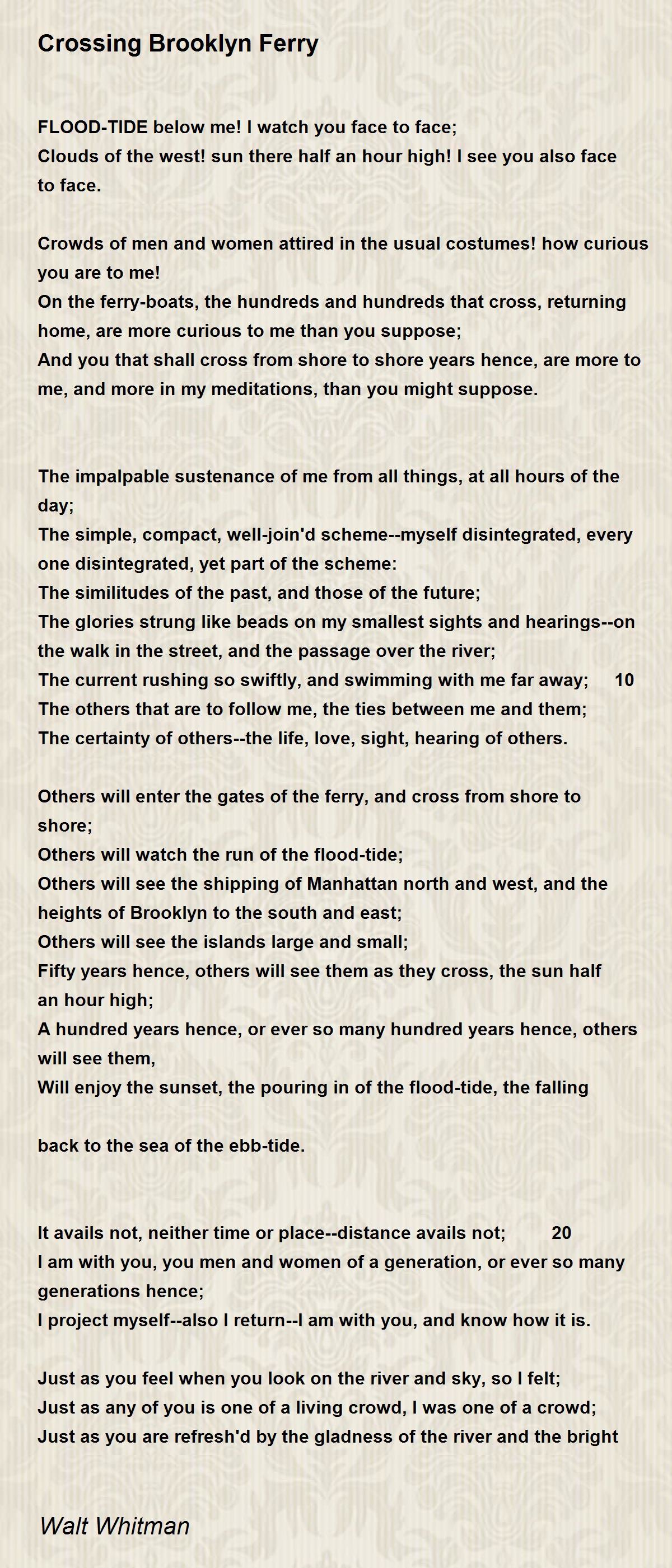
Whitman, like Grainier, views his American surroundings as a fluid environment that rails against remaining static. Both men, distanced by time, one real, the other fictional, are witnesses to the friction elevated by a natural world that is in constant conflict with the ever-growing advent of urbanisation and industrialisation. For a poet like Whitman, whose works are embedded in the soul of the American people and society, his documentation of change is textured by the visual and sonic elements of his periphery and the greater currents that flow through the momentum of history and moments. In the poem, Whitman’s journey across the East River, from Manhattan to Brooklyn, becomes more than a geographical movement, stretching into the metaphysical and historical realms to paint a portrait of a world that is no longer the same, and perhaps, even a person who has themselves recognised their own metamorphoses against these radical external changes. Similar to Grainier’s own exposure to the indifferent discourse of change, Whitman’s narrator unpicks the troubles and difficulties of humanity in relation to nature and its erosion at the hands of civilisation.
In Bentley’s film, Grainier’s life is narrated to us by an unknown presence or voice who regales us with the epic proportions of Grainier’s simplistic arc. This narrative voice punctures Grainier’s history, prodding and poking at the events that defined him without criticism, but instead distillation. Throughout the film, we learn that Grainier lived a long life, meaning that his exposure to the world was undiluted and therefore too large to know entirely. However, the narrator’s pinpointing of Grainier’s orphan childhood, his first encounter with his future wife, Gladys (Felicity Jones), the birth of his child, and the building of a railroad arrive as fundamental narrative pillars that assume foundational bearings for the rest of his life. Warped through the lens of dreams, Grainier’s life is littered with gigantic imagery of tall trees, locomotives, and an expansive wilderness.
Why does Bentley allow these images to intrude into the narrative? Because, without them, we would fail to grasp the gravitational importance of these fragmented images to Grainier’s life as a man fenced into his own reality. Later in the film’s narrative, following the apparent death of his wife and child to a rogue wildfire, Grainier’s dreams are infiltrated by darker images, more mechanical and panic-inducing. While we might infer that his grief is the primary driver of such bleakness, it is also worth considering the historical context.
Around the time of his wife and child’s deaths, Grainier’s time as a logger is waning, and with this, his link to the intimacy of the natural world. Not only does Grainier mourn deeply the loss of family, but also the slow expiry of his craft and reality. Thanks to a slowly depriving post-World War I economy, Grainier is forced to rebuild the material, spiritual, and human conditions of his life. After rebuilding his once immolated cabin and recovering the routine life of a widow and grieving father, Grainier returns to logging, stunned by the advancements that have taken place since his last time in the woods. Chainsaws, the churlish, rougher quality of his new co-workers, and the inching out of the culture he once knew force Grainier to retire from logging again. Almost like witnessing an elderly person perplexed by a mobile phone, Grainier is paralysed by the speed of advancements, and in addition, backed into a corner, as his once pastoral realm is invaded by the unceasing influence of modern civilisation. At this point in the film, the audience is invited to question how a man like Grainier can survive in a modern world.
In Whitman’s poem, the speaker is recognised as being, like Grainier, concerned about his place in a world that forever evolves. Written in his typical stream of consciousness form and style, the poem recounts the speaker’s thoughts and feelings upon a simple geographical navigation, the crossing of a river, and, in doing so, uplifts great metaphorical terrain about the eclipse of time and its infinite mechanics. The speaker’s physical transition, from shore to shore, is positioned as a fixed symbol that mirrors the transition of history as a societal and human process. Whitman’s speaker materialises this in the line “The impalpable sustenance of me from all things at all hours of the day”, where a reflection is channelled as a recognition of how the external world moulds the internal self. Like Grainier, the narrator witnesses the influence of the material reality, or as Whitman puts it, “all things,” on how we feel, in motion, living and breathing in a world that one day might not recognise us, as much as we might not recognise it.
The multi-faceted metropolis of New York during Whitman’s time was undoubtedly in growth, multiplying year by year, stubbornly encroaching upon more land, as people were displaced or aggrieved by the abolition of the natural world for the benefit of a greying citadel. As Grainier struggles with the realisation that the modern world has overtaken him, Whitman’s speaker heightens this truth: “It avails not, time nor place—distance avails not”. For the metric of distance is not only a measure of place between places, but of time between times or moments between moments. The verb “avails” is repeated because Whitman’s emphasis is on the coarseness, or difficulty of change. Both the poem’s speaker and Grainier’s dislocation are made more problematic because their abandonment of progress doesn’t just happen by chance, but instead through force. The ferry to Whitman is more than a water-faring vessel; it is articulated as an unhaltable exposure that, despite the ease of its movement, is a transitional aggression against the speaker. In being overwhelmed and as a byproduct, introspective, the speaker’s journey mirrors Grainier’s return to logging, an epiphanic process that is abrasive and discomforting to those who experience it. Whitman’s titular ferry is symbolic in its relevance as a modern, industrially built vehicle that, like Grainier’s oneiric, titular train, cuts a path through terrain, motioning forward, uninterrupted, like the future itself.
But it isn’t all doom and gloom. Change, nor the future, isn’t all bad; it just takes some time to adjust. Despite Grainier’s difficulty in fitting in, the teething issues of his assimilation into the new world are enriched by his eventual delight at what it has to offer. In the latter half of the film, Bentley careens Grainier away from total oblivion, forcing him to encounter the future in all its glory. Whether it is the kind friendship of fellow nature enthusiast Claire Thompson (Kerry Condon), Grainier’s riding of the Great Northern Rail into Spokane, across the bridge he once helped build, or witnessing televised footage of John Glenn’s space flight, Grainier is encouraged to challenge his own reluctance toward progress.
Still, he remains troubled by the ghostly attendance of his wife and daughter, and by the recurring presence of a fellow rail worker whose violent death he witnessed years earlier. The man, a Chinese labourer employed on the railroad, was murdered in a racially motivated attack, one of many acts of hatred that accompanied the westward expansion Grainier once believed in so wholeheartedly. These memories intrude upon his dreams, surfacing as reminders of the human cost buried beneath steel tracks and national triumphs. Yet in daylight, the sheer duty of the world to astound and amaze, to move forward despite its brutal inheritance, allows Grainier’s fire to burn a little longer, even as it flickers beneath the weight of what cannot be undone.
At the film’s close, Grainier is shown in flight, a passenger on a biplane that pirouettes through the still air. Bentley faces the lens towards Grainier, who is grinning and ecstatic at the miracle of flight. Sure, his past and the comforts of what he has known have eked out of his grasp, but Grainier learns that the future and present are still within reach. As the narrator comments, Grainier, in his twilight years, “only just beginning to have a faint understanding of his life, even though it was now slipping away from him”. Yes, his happiness is gifted as some solace at the endpoint of his life and grief, but it is helped along by the modern world. In some ways, Bentley articulates that Grainier’s upheaval of his burdens and his societal abandonment arises from the miracle of modernity, which at first saddled him with confusion and alienation, and is now a different way to witness the world, and through that himself.
Whitman’s speaker explores similar territory, expanding his concerns, and in doing so, coming to terms with some form of acceptance that, despite the harshness of the moving world, he will find some place in it. In the poem, a refraining positivity is upheld in its margins, “What is it then between us? What is the count of the scores or hundreds of years between us?” The repeated rhetorical questions flesh out Whitman’s anxieties, that time and distance enforce displacement, but ultimately these influences also have the power to unify, as we do not experience time alone, but together, as a collective “us”, not a singular I.
Whitman’s narrator ultimately arrives at a similar point of reconciliation, where the turbulence of change gives way to a renewed openness toward the world. As he writes, “We receive you with free sense at last, and are insatiate henceforward”, a declaration that mirrors Grainier’s late-life ability to encounter modernity not as a threat, but as a source of astonishment and peace. In both instances, acceptance does not emerge from mastery or control, but from surrendering to the forward motion of time itself. What once appeared violent and alienating is refigured as something expansive, even beautiful, allowing both Whitman’s speaker and Bentley’s protagonist to recognise that survival within modernity is not achieved by resisting its force, but by learning how to witness it with wonder.
Cinema, like the river Whitman crosses or the train Grainier rides, moves forward whether we are ready or not. Yet in watching, reflecting, and accepting its changes, we discover that both art and life can astonish, console, and endure. Netflix’s interventions may unsettle traditional screens, but they also bring new stories, new visions, and new opportunities for audiences to witness the world afresh. In this way, change, whether in industry, landscape, or life, becomes not a threat but a chance to engage with the unexpected and the extraordinary.